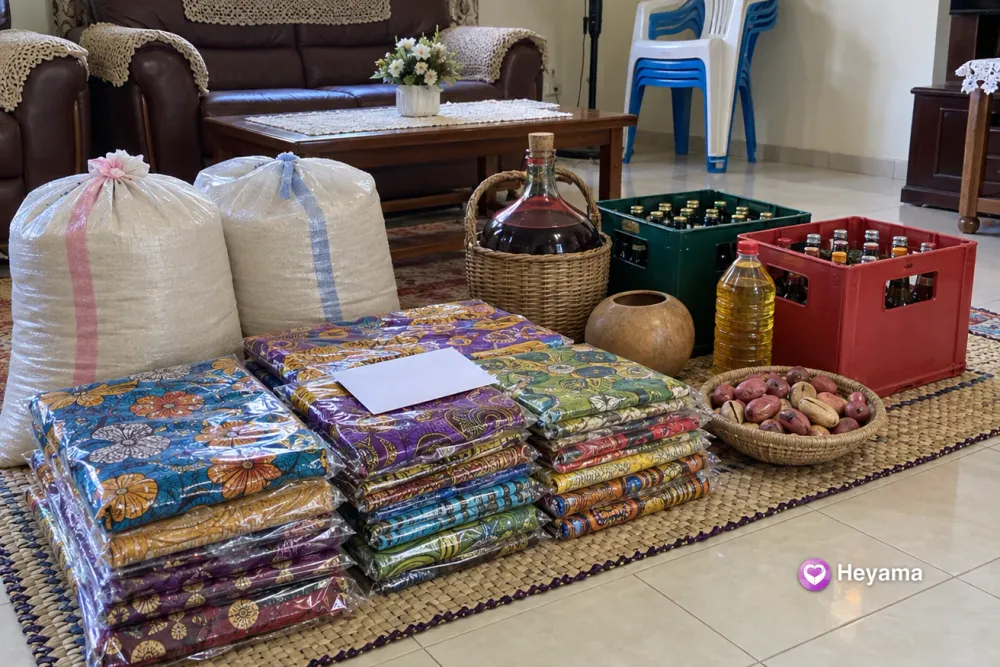
Bride price is the money and gifts that a groom and his family give to the bride's family to seal a customary marriage. In Cameroon it's called la dot, and it's often the day two families meet properly for the first time: the groom's side arrives with drinks, fabric and an envelope, the elders talk, everyone eats, and from then on the couple is married in the eyes of both families.
Here's how it usually works in Cameroon, what goes on the list, and how to talk about it as a couple before the uncles take over. If you're the partner marrying into a Cameroonian family, there's a section for you too.
What is bride price, and is it the same as a dowry?
No. A dowry traditionally goes from the bride's family to the husband. Bride price, also called bridewealth, goes the other way: from the groom's family to the bride's. The French word dot adds to the confusion, because in French it means both.
It isn't a purchase, even if some uncles love that joke. The idea is closer to this: we recognise your daughter, we thank the people who raised her, and our two families are now linked. Many couples see it less as a payment and more as the moment their families publicly say yes.
There's also no single Cameroonian version. Steps, gifts and symbols vary from one community to the next, and often between families from the same village. What follows is the common thread. The details come from your family and theirs.
How bride price works in Cameroon, step by step
1. The knock door
In anglophone Cameroon people call it the knock door; in French, toquer à la porte. The suitor visits the bride's family with a few relatives, usually an uncle or elder who speaks for him, and drinks for the head of the family. They introduce themselves and state why they've come. In many families, the bride is then called in and asked in front of everyone whether she knows this man and agrees. That public yes matters.
2. Receiving the list
If the family agrees, they prepare a list of what the groom's side should bring. Some hand it over on the first visit, others at a second meeting. It's rarely written by one person: the father, uncles, aunts and sometimes the head of the extended family each add their line. This is also where the negotiation starts, and it can take a while.
3. The bride price day
On the day, the groom's family arrives with the gifts, often as a procession. The two families sit facing each other, spokespeople take turns, the list is checked, missing items are discussed, there's a lot of laughter and a bit of haggling. In some families, several women are presented under veils and the groom has to find his bride, paying a small symbolic fine for every wrong guess. Then come the elders' blessings, palm wine and kola shared between both sides in many regions, and food and music late into the night.
What's on a bride price list?
Every list is different, but the same kinds of gifts come up again and again. Use this to read the one you'll receive.
| For whom | Often on the list | What it says |
|---|---|---|
| The bride's father | A suit or traditional outfit, shoes, sometimes a hat or walking stick | Respect for the man who raised her |
| The bride's mother | Wax print fabric, a kaba (a loose traditional dress), a headscarf, cooking pots | Thanks to the woman who carried and fed her |
| Uncles, aunts, brothers and sisters | Envelopes, fabric, sometimes named gifts per person | The marriage involves the whole extended family |
| The whole family | Drinks (wine, beer, soft drinks, palm wine), bags of rice, salt, oil, soap, tinned food, sometimes an animal (goat, pig or sheep depending on the region) | Enough to host, share and celebrate |
| Elders and tradition | Kola nuts, palm or raffia wine, ritual items specific to the family | The link with the ancestors and the blessing |
| The family (money) | A main envelope, sometimes several | The most discussed part, and often the most symbolic |
Always ask the family concerned for their exact list. The "standard lists" that do the rounds on WhatsApp give you an idea, not a rule.
How much is bride price in Cameroon?
There's no fixed amount, on purpose. It depends on the region, the family, the length of the list, how many guests there are to feed and what both families consider fair. Two ceremonies on the same street can look nothing alike.
What often costs more than the list itself: transport for both families, the food and drinks on the day, matching outfits, renting chairs and a canopy. Budget for the whole event, not just the list. And a reasonable bride price isn't a cheap one. Plenty of families care more about the gesture than the figure, and will say so when they're approached with respect.
Talk about it as a couple before the families do
This is the step everyone skips, and it's the one that prevents fights. Before the first visit, sit down together on a quiet evening and agree on these:
- Who pays for what? Traditionally the groom and his family. In real life, many couples pool their money quietly. Decide together, without shame.
- What's the ceiling for the bride price and the party, without debt and without emptying the savings meant for your home?
- Who speaks for each family? Pick calm spokespeople, not the uncle who enjoys a scene.
- What happens if the list goes over budget? Who calls whom, and with what words?
- Customary only, customary then civil, or all three with a church or mosque wedding? In what order, and over how long?
- What's non-negotiable for each of you? For one, it's the grandfather's blessing. For the other, not starting married life in debt.
Money is one of the topics couples argue about most, so if this conversation feels hard, you're normal. Our guide to the causes of conflict in a couple and how to defuse them can help you set the ground rules.
When the list is too heavy: negotiating without offending anyone
It happens. An aunt adds a television, an uncle doubles the envelope. Don't panic, and please don't send an angry message to the family WhatsApp group.
- Use the right channels. Negotiation happens between spokespeople and elders, not between the groom and his future mother-in-law.
- Ask what matters most. One simple question often opens the door: "What is most important to the family on this list?"
- Offer, don't refuse. "We'll bring this now and this later" lands better than a flat no. Many families accept that a bride price can be completed after the ceremony.
- The bride has a voice. If her family is overdoing it, she's often the one who can say so most gently, through her mother or a trusted aunt.
If it turns into a power struggle, step back together. A family that listens during the bride price talks is usually a family that will listen during the marriage.
If you're marrying into a Cameroonian family
Maybe you grew up in Manchester, Toronto or Atlanta and your partner's parents live in Yaoundé. A few things will make you very welcome:
- Let your partner lead. They know which uncle to call first and which topics to avoid at the table.
- Bring someone. Turning up alone is unusual. A friend, a parent or a respected older person who can speak for you shows you take it seriously.
- Don't discuss money directly with the parents. It goes through spokespeople, and that's a sign of respect, not secrecy.
- Ask about clothes. Matching fabric for your side is common, and wearing it means a lot.
- Learn two greetings in your partner's language. It costs you an evening and wins you the aunties.
Planning it from abroad
Living in Paris, London or Montreal while your partner is in Douala is very common, and it can be organised.
- Set the date early to line up flights, time off and the elders' availability.
- Appoint someone you trust on the ground, a brother or a cousin, to buy, store and transport the gifts. Buying locally saves you excess baggage and customs fees.
- Keep a written record of what's bought and paid for, especially when money goes by transfer or Mobile Money. That's not mistrust, it's organisation.
- Suggest a video call with the elders if you can't be there for the knock door. Some families accept it for the first step, far fewer for the day itself.
If you already live apart day to day, read what it takes to make a long-distance relationship work.
Bride price, civil marriage and religious marriage
Bride price seals the customary marriage in the eyes of the families. For the state, what counts is civil registration: either a civil wedding at the town hall, or having the customary marriage recorded in the civil register.
As of October 2026: Law No. 2024/016 of 23 December 2024 reorganised civil registration in Cameroon. According to the National Civil Status Bureau, quoted by Journal du Cameroun in January 2025 (in French), couples married under custom can declare their marriage to a civil registrar to have it recorded. The request is published, and after 30 days with no objection the marriage is recorded and the couple receive a marriage certificate. Required documents can vary, so ask your town hall's civil status office for the exact list, and your consulate if one of you lives abroad.
A church or mosque wedding follows its own rules. Many couples do all three, over a few weeks or a few years. What matters is that you discuss it beforehand, so each of you knows what you're signing. For the long run, our tips for a marriage that lasts apply whatever form yours takes.
Bride price FAQ
Is bride price compulsory in Cameroon?
A civil wedding at the town hall takes place without one. But in most families, bride price is still expected before the couple is considered married. It's a family matter more than a legal one.
Who pays the bride price?
Traditionally, the groom and his family. In practice, many couples organise it together. What matters is that the two of you agree.
Can the groom be absent?
Some families accept a representative, especially if the groom lives abroad. Others insist he's there. Ask before you book or cancel a flight.
What happens to the bride price if the couple separates?
Depending on the family and region, returning the bride price can come up. It's settled between families and elders, and sometimes in court. One more reason to keep a record of what was given.
One last thing. Bride price is the story of two families, but it starts with two people who want the same thing. If you're still looking for yours, on Heyama you can pick the Wedding intention and spot the profiles that chose it too. Join Heyama and meet someone who shares your roots.